
Breast Cancer Surgery
Breast Health Resources > Breast Cancer Surgery
Understanding Your Surgical Options
Surgery is a common and effective part of breast cancer treatment, and understanding your options is an important first step. There are two main surgical approaches - mastectomy and lumpectomy, and each are designed to remove cancer while supporting your overall health and recovery. The right option for you will depend on your specific diagnosis, as well as your personal preferences. Your care team will walk you through these choices, answer your questions, and help you feel confident in the path forward.
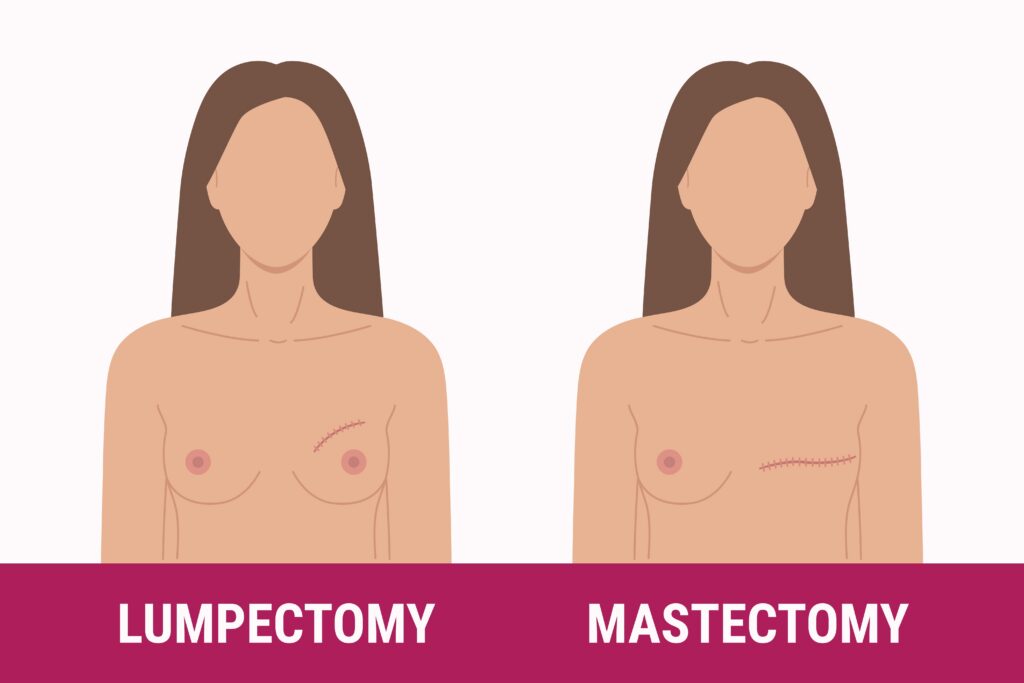
Mastectomy
A Mastectomy is a surgery to remove the whole breast. The goal is to remove cancer in the breast and try to prevent the spread of cancer. Other names for mastectomy are: Simple Mastectomy and Total Mastectomy.
The Five Steps of a Mastectomy
- You will be given general anesthetic medication to help you relax and sleep through surgery.
- The whole breast will be removed. If you are not having breast reconstruction, the nipple, areola, and some skin will be removed. If you are having a breast reconstruction, some skin and sometimes the nipple and areola are kept. This will be discussed with your surgeon during the consultation.
- The breast tissue removed during surgery is sent to a pathologist who will test the body tissue for disease.
- One or two tubes will be placed- these are called drains. The drains are there to help remove fluid from the surgery area and prevent swelling.
- The incision is closed with stitches. These stitches will dissolve on their own and will be covered with a skin tape called “Steri-Strips”. A bandage will be used to cover the whole area.
A mastectomy with lymph node surgery can take up to 2 hours. If both breasts are removed or if there is breast reconstruction, the surgery will take longer. Here's how to prepare for a mastectomy.
Lumpectomy
A lumpectomy is a surgical procedure that removes a portion of the breast tissue while conserving most of the breast. It is also known as Partial Mastectomy, Wide Excision, Wedge Excision, Excisional Biopsy, or Breast Conservation Surgery.
Having a Lumpectomy
- You will go home the same day as your procedure. Lumpectomy surgery takes about an hour, but plan on being at the hospital or surgical center for most of the day.
- You may need localization placed into the breast to guide your surgeon to the area needing to be removed. We will tell you if you need this and make all the arrangements. During the lumpectomy procedure you will be given general anesthetic (medication to help relax and sleep through the surgery).
- When the lump is found, an incision will be made and the lump with the tissue around it will be removed.
- Your incision is then closed with stitches; the stitches will dissolve on their own and will be covered with a skin tape called Steri-Strips. A bandage will be used to cover the whole area.
- The breast tissue that was removed during surgery will be sent to a pathologist, who will test the tissue to see if there is disease there.
Your health care team will set up a follow-up appointment for 1 to 2 weeks after your surgery. You will get the results of your pathology test at this appointment. Here's how to prepare for a lumpectomy.