
Benign Breast Conditions
Breast Health Resources > Benign Breast Conditions
Breast Pain
Breast pain (mastalgia) is common, usually related to hormonal changes (cyclic) or other factors like injury, cysts, infection (mastitis), or chest wall issues (non-cyclic).
Common Symptoms
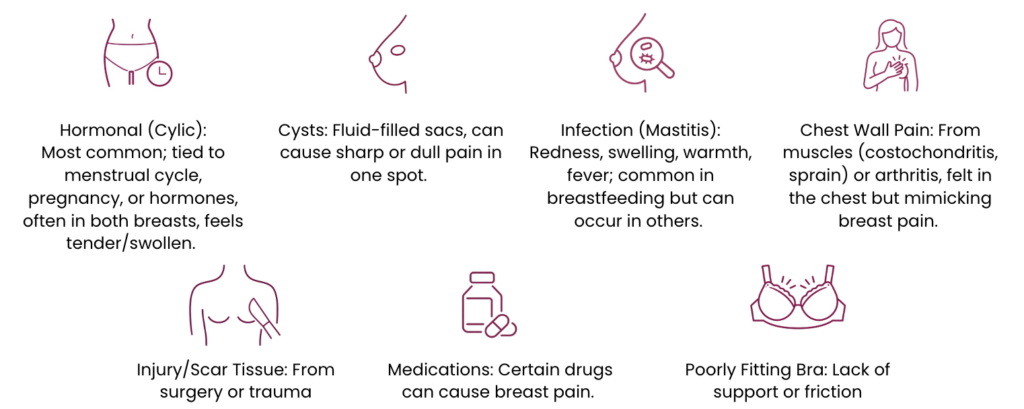
Management & Relief
- Support: Wear a well-fitting, supportive bra (like a sports bra).
- Pain Relief: Acetaminophen or ibuprofen (talk to your doctor).
- Topical Gels: Diclofenac gel might help.
- Diet: Some find reducing caffeine and fat helpful, though studies are mixed.
- Hot/Cold: Warm or cool compresses.
- Recent research suggests that combining Evening Primrose Oil (e.g., 3,000mg/day) with Vitamin E (e.g., 1,200 IU/day) might offer superior relief for breast pain.
If your pain lasts longer than a month and stays in one area, or if you notice a new lump that doesn’t go away in a few days, or you develop redness, swelling, pus, fever, or nipple discharge, please contact us. Our Nursing Triage (Navigation) system may ask you to see someone in the clinic if your problem cannot be managed at home.
Breast Infections
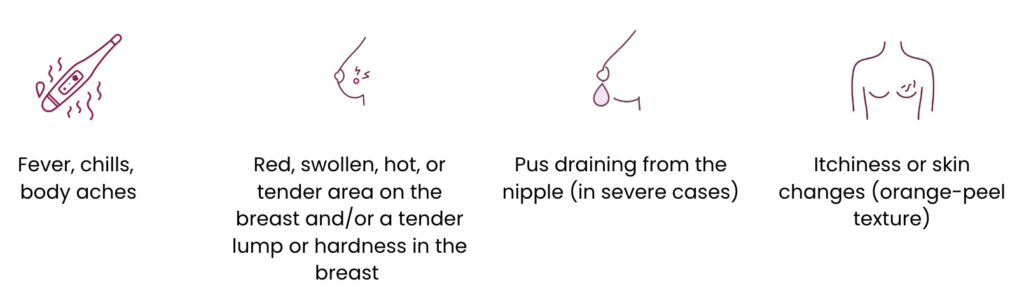
A breast infection, often called mastitis, is inflammation or infection of breast tissue, common in breastfeeding mothers due to blocked ducts or bacteria entering cracked nipples.
Common Symptoms
Treatment & Management
Please call the office immediately if you develop these symptoms. Our nurse triage (Navigation) team will arrange for an immediate appointment if the problem requires you to be seen
- Antibiotics: A 10-14 day course is often prescribed.
- Emptying the Breast: Continue nursing or pumping frequently to prevent milk stasis.
- Pain Relief: Over-the-counter pain relievers.
- Warm/Cold Compresses: To soothe discomfort.
- Lactation Support: For latch/positioning issues.
- Abscess Drainage: Surgery may be needed for pus-filled abscesses
Breast Lesions
A benign breast lesion is a noncancerous breast change, like a lump, cyst, or abnormal tissue, that isn't cancer and doesn't spread. They are evaluated to ensure that they do not pose a risk to health.
Common Types of Benign Breast Lesions
- Breast Cysts: Fluid-filled sacs that feel soft, smooth, or rubbery.
- Fibroadenomas: Solid, rubbery lumps that move easily under the skin, common in younger women.
- Fibrocystic Changes: Lumpy or rope-like breast tissue, often related to menstrual cycles.
- Sclerosing Adenosis: Overgrowth of milk-producing glands, can feel like a mass.
- Fat Necrosis: A lump from damaged or dead fat tissue, often after injury or surgery, forming a firm lump or oil cyst.
Common Symptoms
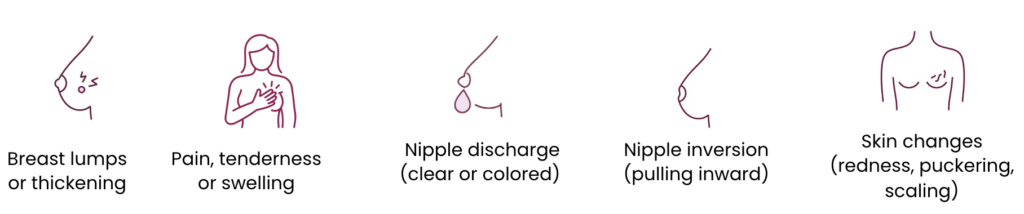
Treatment & Management
Diagnosis often includes a clinical exam, imaging, and sometimes a biopsy. Management can vary from simple monitoring to medication to surgical interventions.
While a benign lesion isn't cancer, any new breast change warrants evaluation by a doctor to rule out malignancy and determine the best management. Call our team to schedule an appointment.
ANY NEW BREAST CHANGE WARRANTS EVALUATION BY A DOCTOR TO RULE OUT CANCER AND DETERMINE THE BEST MANAGEMENT. CALL OUR TEAM TO SCHEDULE AN APPOINTMENT.